Research · 2025–2026
Impact Evaluation of Costa Rica's National Judicial Facilitators Service
Building the first causal evidence on a nationwide judicial-access program in Costa Rica.
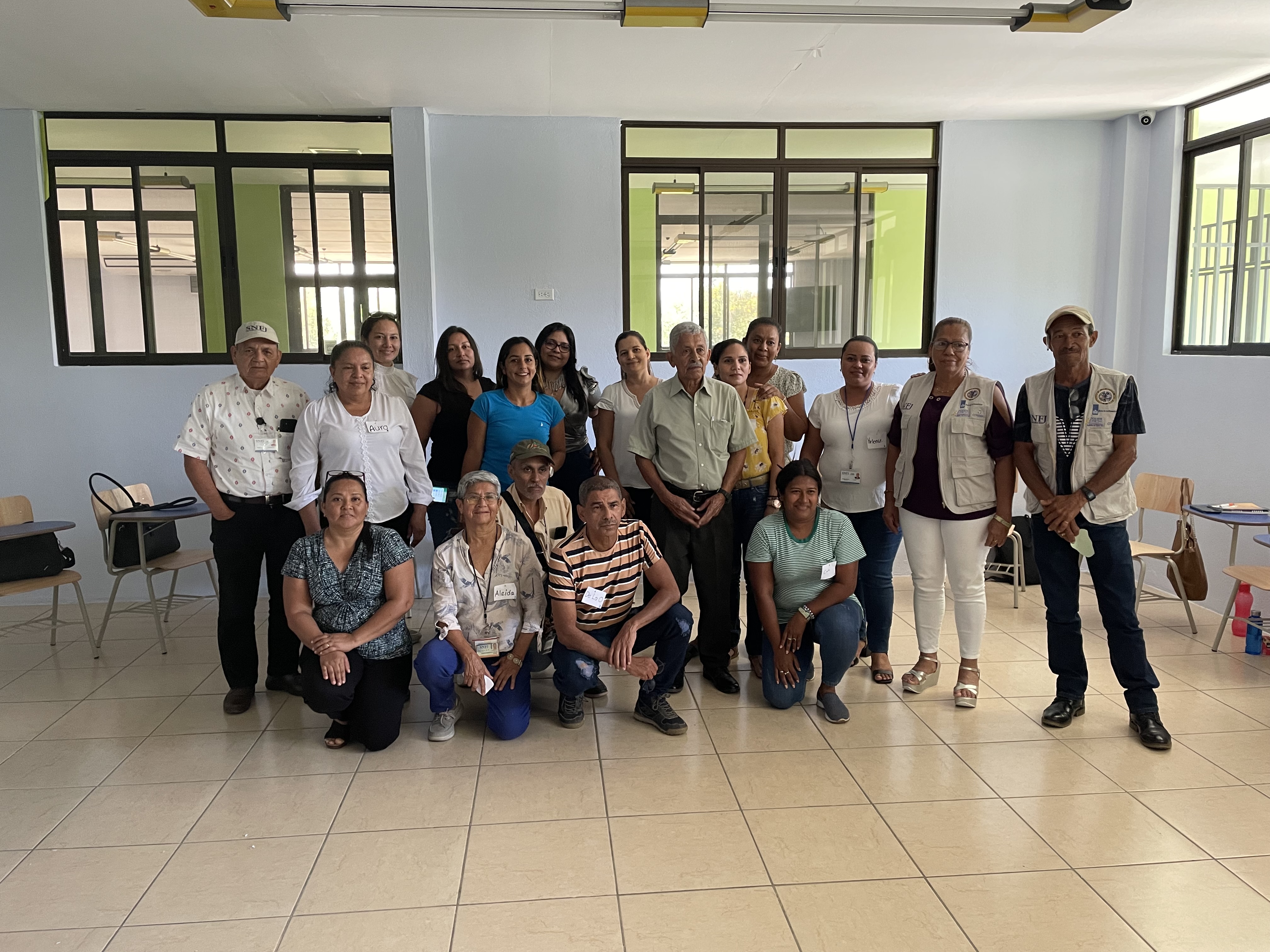
As Senior Policy Analyst at Costa Rica’s Judicial Branch, from 2021 to 2024, I led the implementation of the National Service of Judicial Facilitators in rural areas of the country, and then led its expansion into urban areas. I watched the program change how families accessed the courts, but I also kept hearing the same question from colleagues and critics alike: does it actually work? For a service built to close information gaps and bring justice closer to people who had never had it, there was almost no causal evidence that it did.
That question followed me to the University of Virginia. In Advanced Topics in Impact Evaluation, working with Professor Daniel Player, I built a research design to finally answer it: a difference-in-differences strategy exploiting the program’s staggered rollout across 76 cantons between 2013 and 2022. Drawing on my background in open government data and my relationships inside the Judicial Branch’s Planning Department, I sourced and built an administrative panel dataset from scratch, covering contraventional, family, domestic-violence, and child-support courts from 2000 to 2025. I managed the full data pipeline in Stata, from raw institutional records to an analysis-ready panel, adding every variable the identification strategy required.
I estimated the program’s effect using the Callaway and Sant’Anna staggered difference-in-differences estimator, supported by two-way fixed effects models, event studies, placebo tests, Poisson PPML, and a full battery of robustness and falsification checks. A code sample covering the baseline event-study and two-way fixed-effects specifications, cleaned and reproducible on the analysis-ready data, is public on GitHub (link above).
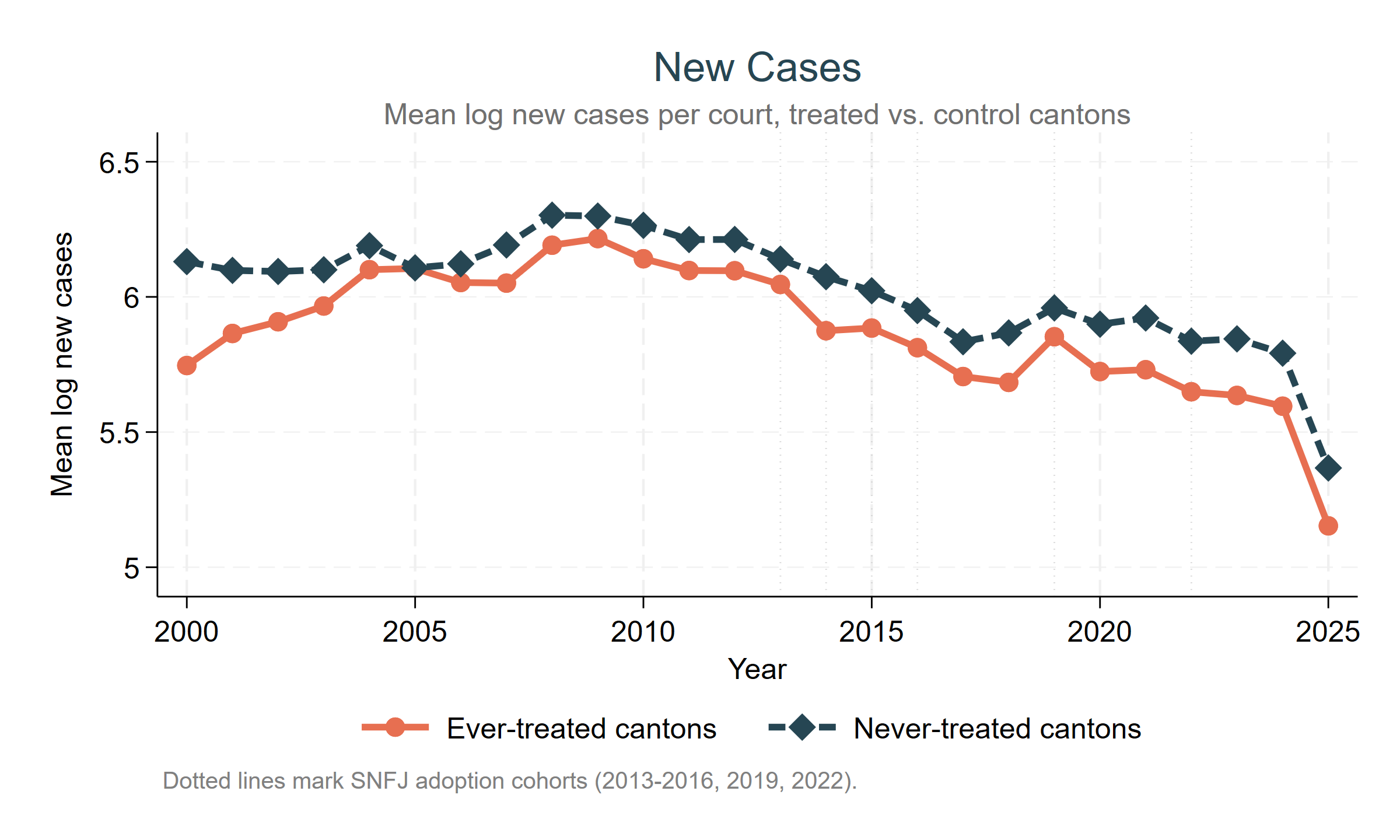
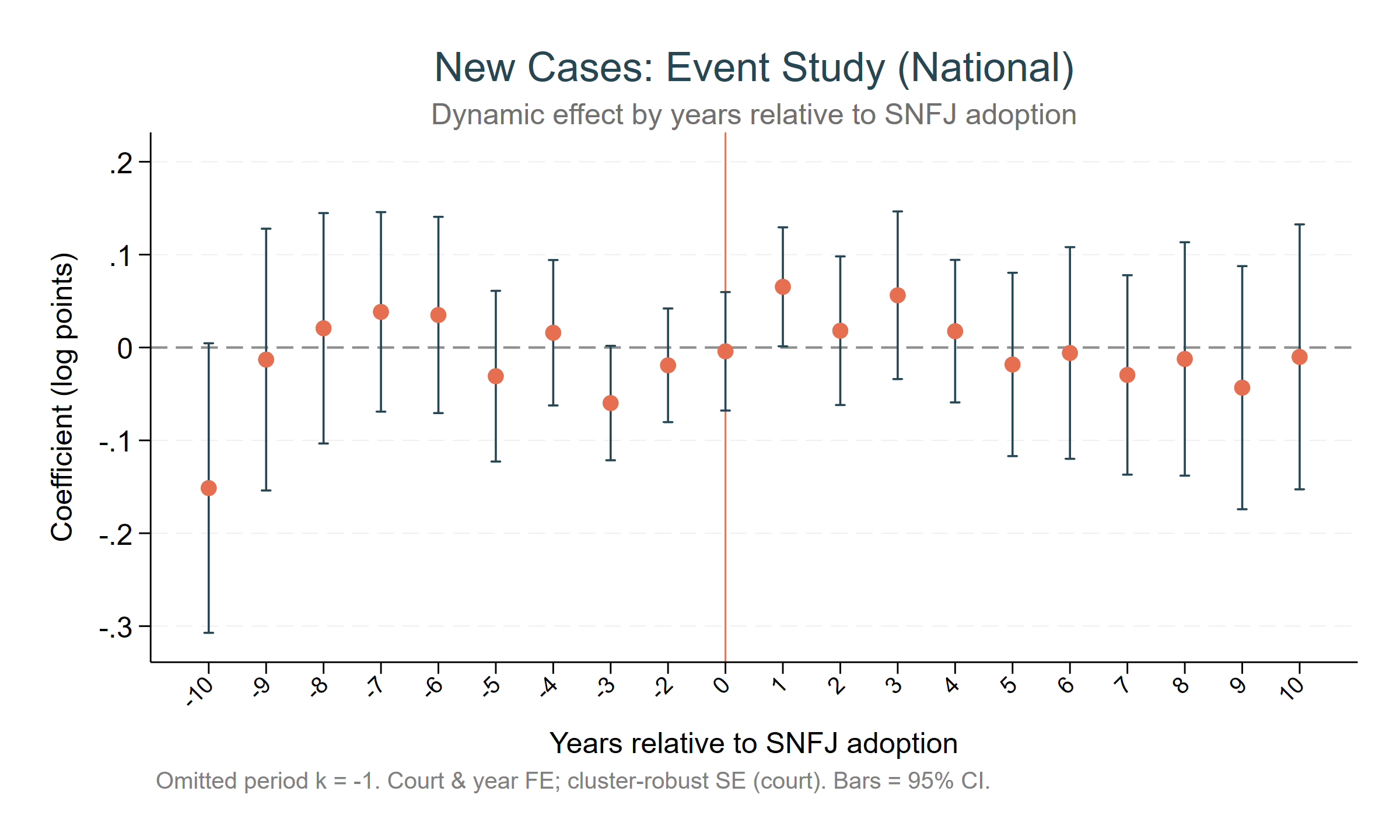
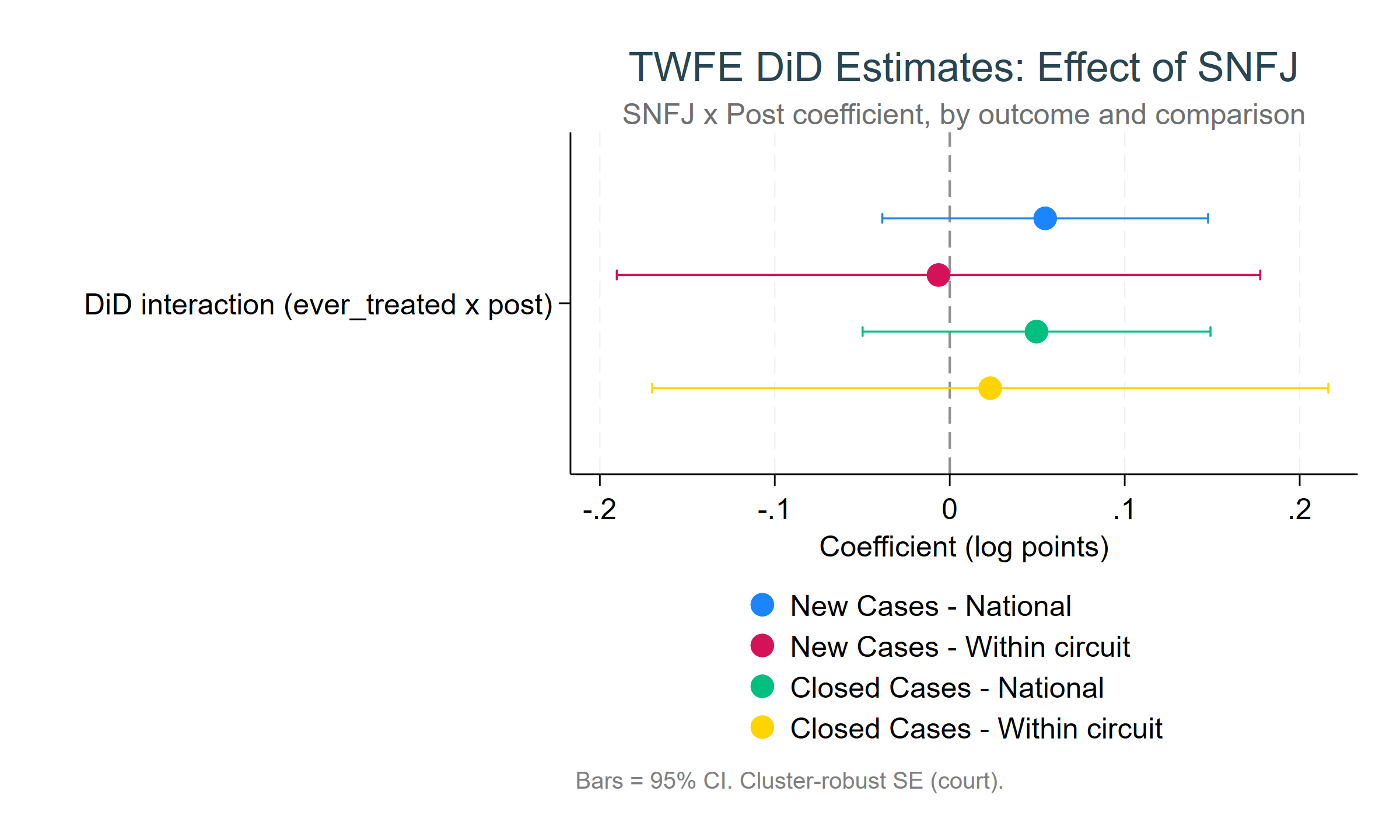
Throughout, I translated the technical work, identification assumptions, model specifications, and diagnostic tests, into plain-language briefs and visual presentations for Judicial Branch officials with no background in econometrics, so the analysis could speak to the people who would eventually use it. The clearest example is below: a presentation I gave to the Judiciary’s Open Justice Commission, an audience of senior officials and staff with no research background, where I explained the logic of difference-in-differences (including the causal-inference intuition, using a plain-language analogy) and what the research design can and cannot tell us.
The research is ongoing. It’s on track to become the first causal evaluation of the SNFJ and, as far as I know, the first quasi-experimental evidence on a national judicial-facilitators service anywhere in Latin America.
Gallery